What Is Menumiru? The Story Behind It
In this post we want to tell the story of Menumiru — how a simple menu translator grew into a smart food companion for Japan. This is the first post dedicated to Menumiru, so let's start from the very beginning.
The Beginning
The project started with a problem:
I travel around Japan a lot, and I always try to visit small local cafés to taste the regional cuisine. But written Japanese is hard for me, Google Translate would translate something unintelligible, and even when I managed to translate a dish's name, it often told me nothing. You always have to ask what the dish even is. And in one of those moments I thought: why not make a better Japanese menu translator and add a description to every dish?
— Andrei Gusev, founder of Menumiru.
Japan is a perfect fit for a product like this. The flow of tourists grows every year. Very few restaurants have an English menu, especially local cafés. And Japanese cuisine is simply amazing — for many travelers it's the number one reason to visit.
The First Version — a Menu Translator
In the very beginning there were just three screens: the camera, the list of scanned menus, and the menu itself. You take photos of the menu pages, send them, and in return you get a list of all the dishes with descriptions in your native language.
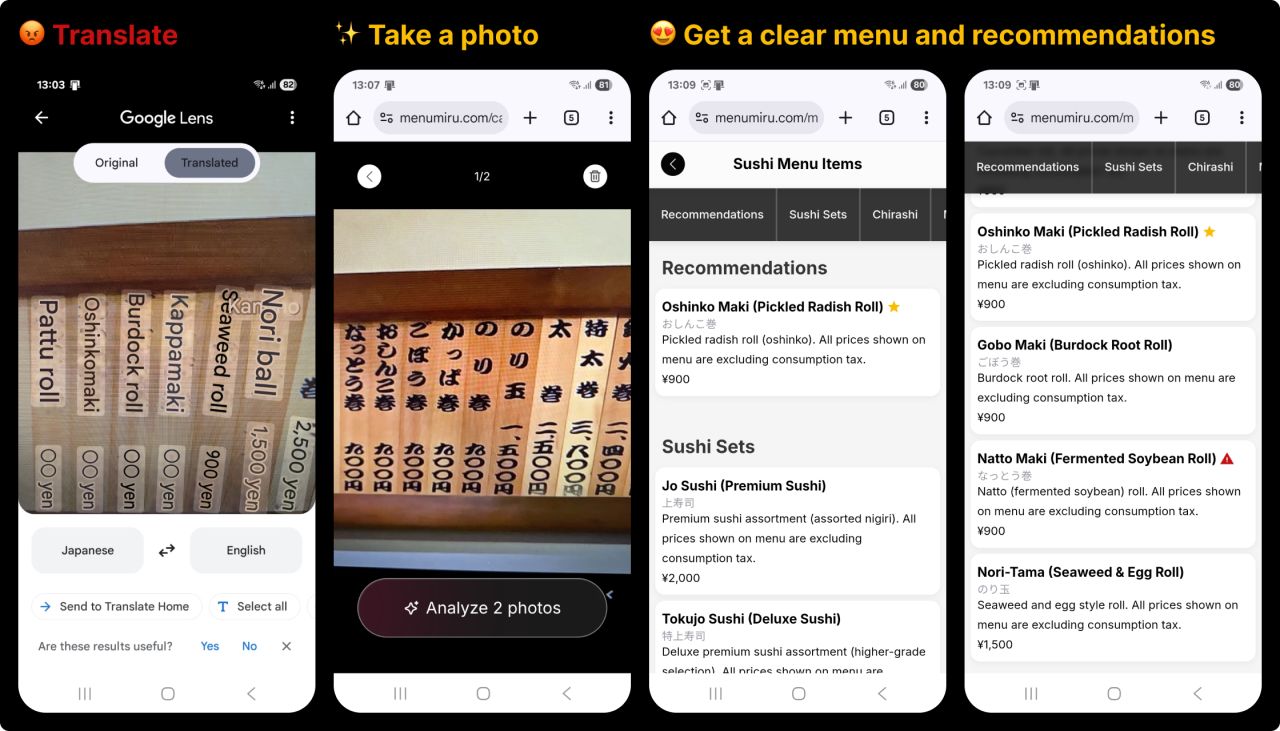
It sounds simple, but at this stage we had a lot of challenges to solve: handwritten fonts, vertical text, stitching several images together, shared prices, and much more. During recognition, several types of AI models worked in the background — combining and recognizing the photos, translating and describing each dish. This process took time, and that was a problem too: we needed to intuitively show the user that everything was fine, the process was running, and they'd soon be able to choose what to order for lunch.
But we managed to make this process as fast as possible and clear for users. And most importantly — the problem of understanding the menu was solved!
Personalization and Search
The most obvious improvement was building a recommendation system — it made the user experience much better. You describe in the settings what you like and what you don't, and Menumiru makes sure you try a dish you'll enjoy and don't accidentally order something you're, say, allergic to.
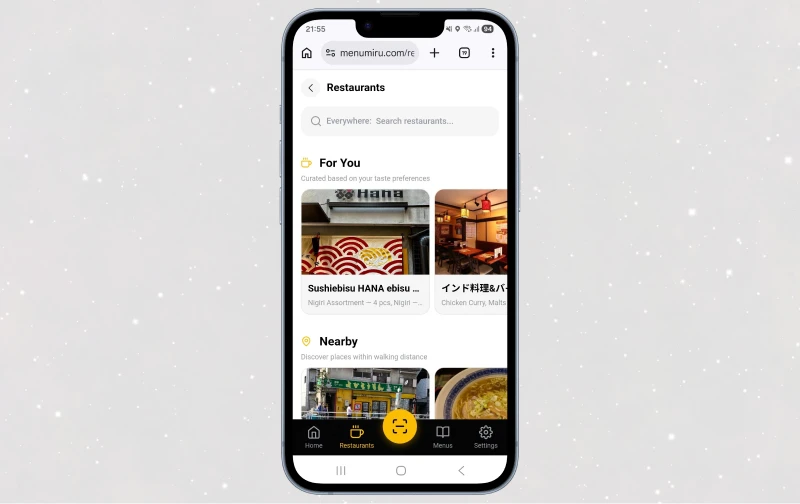
The first users appeared, and we thought: why not make the menus that someone has already scanned publicly available? So we started building a restaurant search: after scanning a menu, you specify which restaurant it belongs to, and other users who find that restaurant will see its menu right away. That's how we defined the core value of the project — a database of restaurants with scanned menus. Back then there were only a couple dozen of them, but the thought of one day having at least a couple thousand was truly inspiring.
By combining restaurant search with dish recommendations, we got a restaurant recommendation system. And the most surprising part — even with a small amount of data, it worked quite well: you could discover new and interesting places.
In parallel, development of an Android mobile app began.
A bit later, an iOS app also appeared in the App Store.
A major milestone was a large-scale redesign of the project. We reworked the restaurant page: where it used to be just a name, an address, and a menu, now there are photos, a description of the restaurant, its features, opening hours, and contacts.
A little later we added likes to dishes — every like you give influenced your taste preferences, which improved both dish and restaurant recommendations.
Content
We kept expanding the restaurant database and describing each place. But there was a problem: Google didn't index them, and they couldn't be found in search. So, to open these restaurants up beyond the project itself, we created a blog. From time to time we started publishing articles about Japanese cuisine, local dishes, and interesting spots — for example, one of the popular articles was about a Starbucks that opened on the 30th floor next to Skytree.
The next important feature was restaurant collections: for example, where to eat for under 1,000 yen, or a collection of restaurants with live music in Tokyo.
A bit later, collections got a big update, and now anyone can create them. Just like a restaurant — and it's already added to your collection. Or you can sort everything into your own lists, like restaurants with a beautiful view or the best breakfasts.
One of the latest additions was events. Japanese festivals, fireworks, street food — that's a whole separate experience that everyone should have at least once. We made a section where you can find all the information about events like these.
We also reworked everything and made it shareable: you can share a restaurant, a scanned menu, or your own restaurant collection with friends.
The Smart Assistant and a Bit of AI Magic
The database kept growing — right now we have over 2,000 restaurants and more than 700 recognized menus. It was time to solve the next problem.
A friend was visiting me and asked for help finding a restaurant to throw a birthday party. We needed sushi, a nice view from the window, and a reasonable budget — a table for four, and not too noisy. I spent days searching across different sites, scanning through hundreds of restaurants with my own eyes. It was a really hard and exhausting process.
— Anna, early Menumiru user.
The idea of a complex search that could solve this problem had been with us for a long time. But we needed a database of restaurants and menus — and now we'd finally accumulated enough data to take on the task.
The first version of the smart search was quite simple: we added everything we could into the search criteria — name, address, description, restaurant features, dish names and descriptions. It sort of searched, but there was a lot of noise: the system didn't understand where the emphasis was or which criterion mattered more — and the magic we'd hoped for just wasn't there.
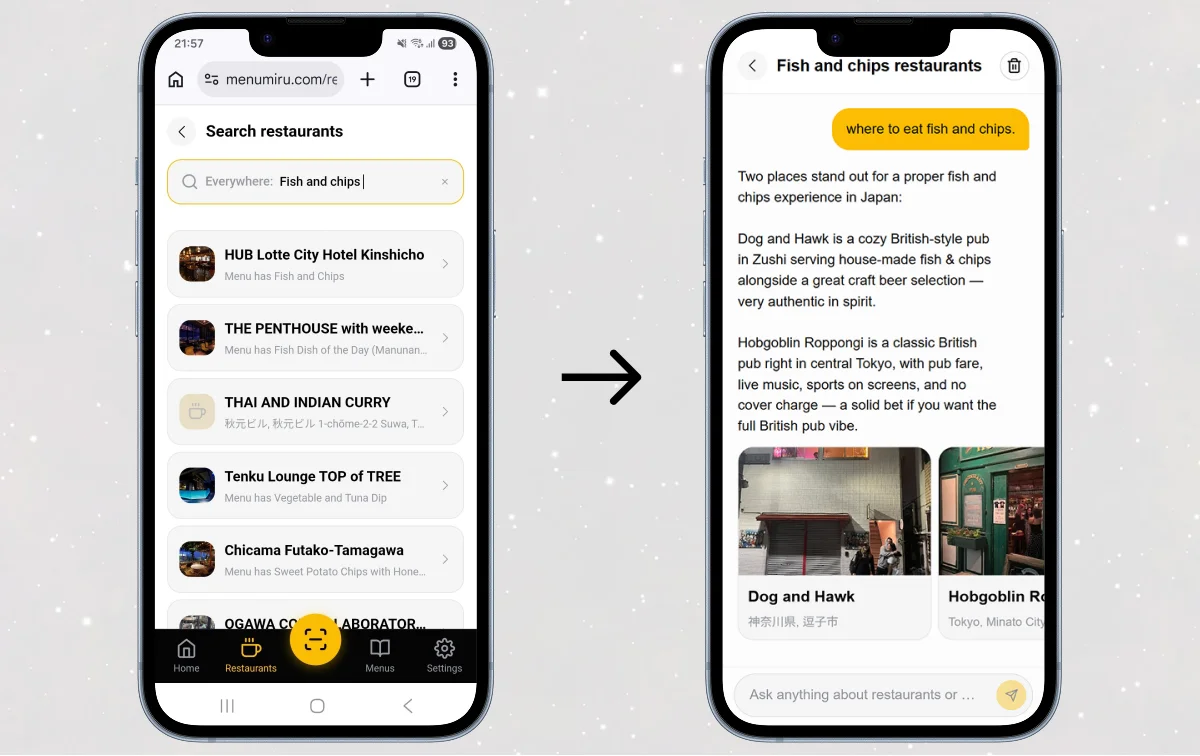
So we decided to create an AI agent that decides for itself how to search: by address, by features, or by dishes. In any language, for any request, even the most complex one. And so, using a bit of AI magic, smart search arrived on Menumiru. We designed it in a format everyone is used to — a chat. Now any request of yours — for example, "where to eat sushi with a view of Skytree" or "where in Tokyo to try Hokkaido-style miso ramen" — the assistant can handle. Or you can ask about a menu, about a dish, or ask it to find other restaurants that serve the same dish. And as the database grows, the assistant will only get smarter. We've added a Discuss with AI button to almost every page: you can talk it through with the assistant — from a menu or a restaurant to a collection or even this very blog.
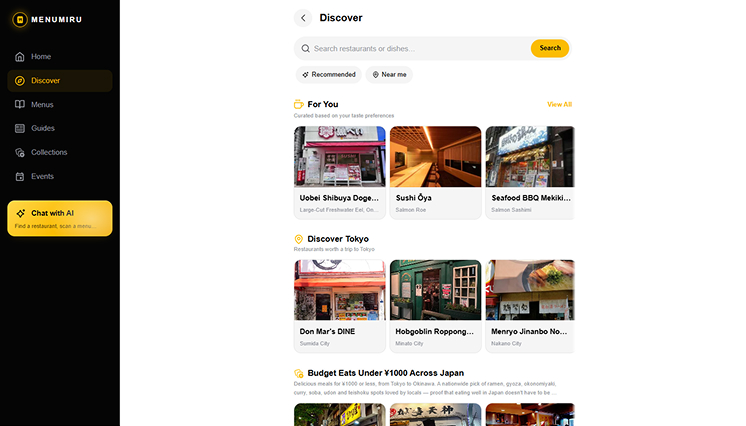
Another big update came to the Discover section — it's now an endless feed of various selections. You'll find not only official collections and blogs, but also picks based on your tastes or on restaurants you've visited. There's always something new and interesting to find.
The Future
Soon the AI assistant will gain many new abilities — for example, it'll send you even more personalized selections.
The Discover section will get even smarter and show you what you actually want.
There'll be an option to share your restaurant collection with all Menumiru users, not just with friends via a direct link.
And most importantly — we'll be developing the business side. Our partner dashboard is already fully ready: we'll offer restaurants the chance to set up an official page, share an official menu with beautiful photos, and get a lot of useful tools for their business and promotion.
Now — try it yourself. Scan your first menu, find a restaurant to match your mood, or just browse Discover. Menumiru is already waiting for you at menumiru.com — and it only gets better from here.