Where to Eat at Night in Japan: 24-Hour Spots & Late-Night Food
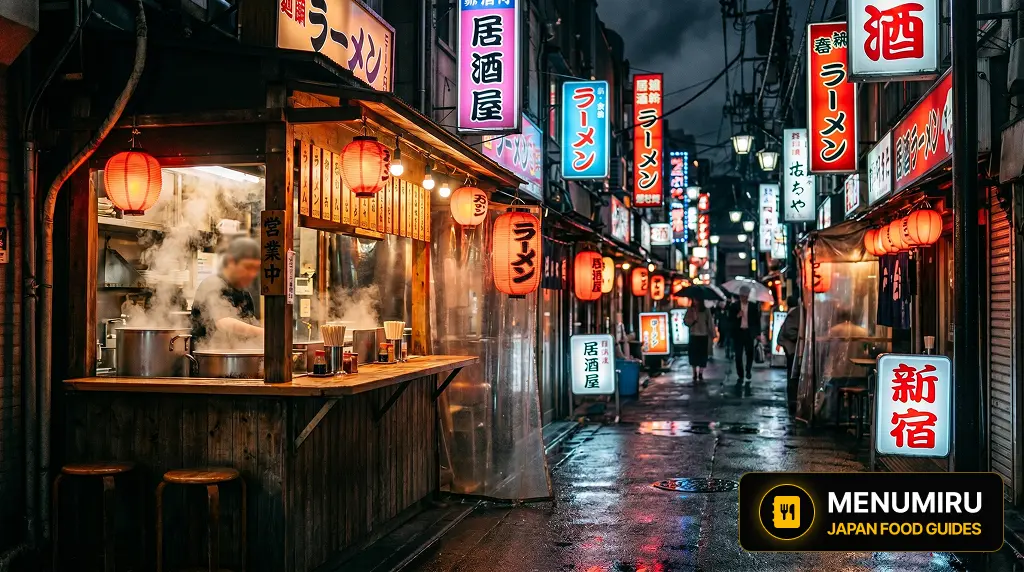
Japan is one of the few countries where "eating at night" doesn't mean settling for whatever's left over. After midnight, it isn't just convenience stores that stay open — full hot kitchens keep running: a bowl of beef over rice in a couple of minutes, a bowl of rich ramen at three in the morning, a yatai stall under a paper lantern by the river. Nighttime eating in Japan is a culture of its own, grown out of the habits of fishermen, night-shift workers, and salarymen who needed a meal before the last train home.
This guide covers where you're guaranteed to be fed after midnight — from nationwide chains with thousands of locations to historic spots with centuries of history.
Good to know: the "late-night charge." Since 2024, many chains have introduced a late-night charge — a 7–10% surcharge on the bill during night hours (usually 22:00 to 05:00). It's a standard practice and it's printed in the menu. So a bowl of gyudon at night will cost a little more than during the day.
1. 🍚 Gyudon Chains: Beef and Rice at Any Hour
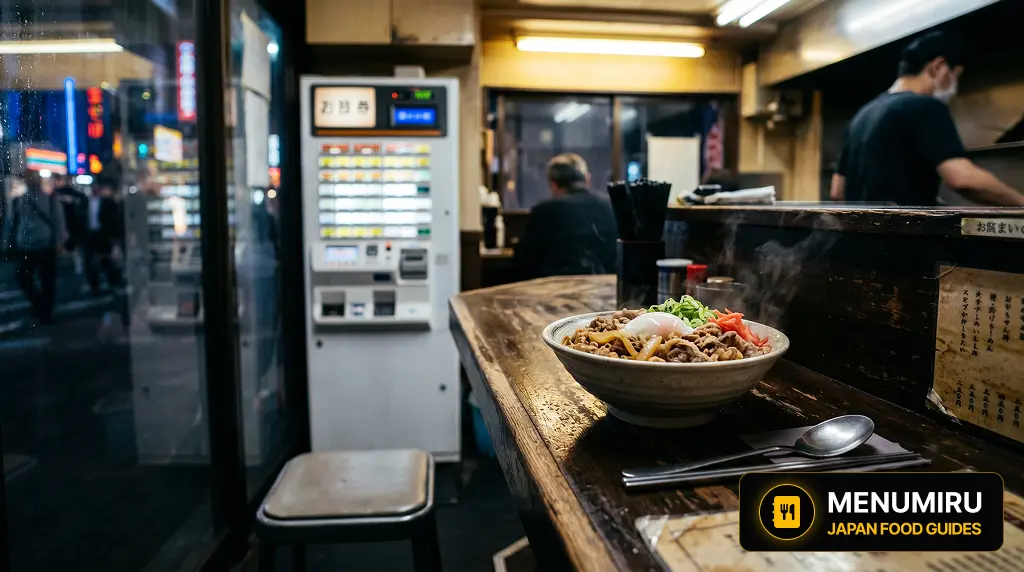
If you remember just one word for late-night hunger in Japan, make it gyudon (牛丼) — a bowl of rice topped with thinly sliced beef simmered in a sweet-savory dashi-based sauce. Cheap (from ~400 yen), fast (served in a minute or two), and almost everywhere. The "big three" gyudon chains — Sukiya, Yoshinoya, and Matsuya — run thousands of locations between them across the country, and a large share operate either around the clock or until 2–5 a.m.
A bit of history. Yoshinoya opened in 1899 in Tokyo's Nihonbashi, right by the fish market — to feed fishermen who needed fast hot food between shifts. A counter, an order, a bowl straight into your hands — that "eat in five minutes and run" model is still alive today. Yoshinoya opened its first 24-hour shop back in 1952. That very "Shop No. 1" is still running today, though it has moved several times following the fish market: from Nihonbashi to Tsukiji (1926), and in 2018, when the market relocated, to the new Toyosu market, where it stands now.
The numbers. Sukiya is the country's largest gyudon chain, with about 1,950 locations across Japan. Yoshinoya has roughly 1,200 restaurants. Matsuya has more than 1,000 locations across 30+ prefectures, and it's Matsuya that has historically had the highest share of 24-hour outlets (over 300 in Tokyo alone).
How to order. Usually via a ticket machine at the entrance or a tablet on the table — Sukiya and Matsuya have an English interface in tourist areas. Choose a size (from mini to mega), pay, hand over your ticket, and wait a couple of minutes.
Tip. Sukiya and Matsuya are a bit more "family-style" (with tables and a broader menu — curry, teishoku set meals, breakfasts). Yoshinoya is more austere and focused on gyudon. Note that after a series of reforms, Sukiya is scaling back some of its 24-hour outlets — it's best to check specific hours in the app or on a map.
Where to Eat
Yoshinoya "Shop No. 1" at Toyosu Market (吉野家 豊洲市場店) — a legendary spot. The original "Shop No. 1" of the Yoshinoya chain — the direct heir of the shop that fed fishermen at Tsukiji from 1926 and relocated with the market to Toyosu in 2018. The "connoisseur's" gyudon tradition still lives here: fishermen order it their own way — negidaku (extra onion), tsuyudaku (extra sauce). Prices and hours differ from regular outlets. It runs on the market's schedule — early morning, roughly 5:00 to 13:00 — so it's not a nighttime but a "dawn" option: perfect for ending your night with a bowl of gyudon where the whole chain began.
Matsuya Shibuya Center-gai (松屋 渋谷センター街店) — 24 hours by the Scramble. A 24-hour outlet on Shibuya's main street, Center-gai, a couple of minutes from the Scramble Crossing — the most famous pedestrian crossing in the world. The ideal "anchor" for a night out: after the clubs and bars of Shibuya, you can drop in for a bowl of gyudon without leaving the center of the action. Order via machine; Matsuya's signature touch is a free miso soup with every order.
Sukiya near Shinjuku (すき家) — 24 hours at the epicenter of the night. Outlets of the country's largest gyudon chain are scattered all over Shinjuku — Tokyo's most "sleepless" district — and many are open around the clock. When the nightlife hums until dawn all around you, a bowl of hot gyudon for a couple hundred yen is the best anchor there is. Each spot has an ordering tablet with English; besides beef there's curry, eel, and miso ramen. Look for the nearest outlet near Shinjuku Station or in Kabukicho.
Matsuya Iriya (松屋 入谷) — the model late-night "solo counter". If you want quiet rather than chaos, here's the benchmark for late-night gyudon for one. A 17-seat room, a single counter, a minute from Iriya Station: walk in, order via machine, eat in silence. The full menu is available 24 hours — gyumeshi, curry, sets, morning teishoku. One catch: e-money and QR only, no cash accepted.
Nakau (なか卯) — gyudon + udon, the "fourth" chain. If the "big three" have worn thin, try Nakau, a lesser-known chain (about 470 locations) that pairs gyudon with udon and its signature oyakodon (chicken and egg over rice). Many outlets are open around the clock; order via machine. A great way to mix up your night menu — for example, the Nakau Shinjuku Shokuan-dori branch in Kabukicho.
2. 🍜 Ramen Until Dawn: A Hot Bowl at Three in the Morning
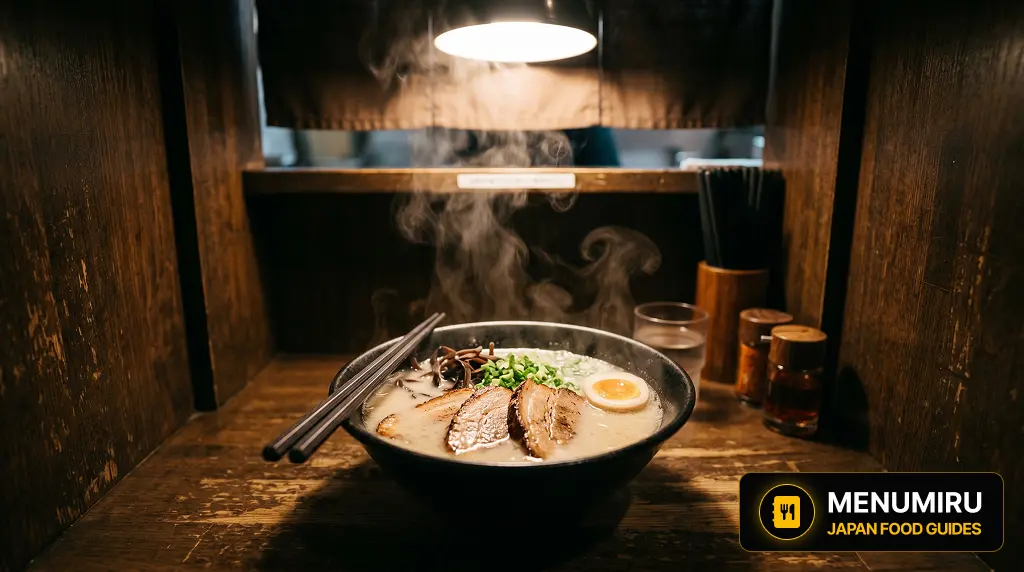
Ramen and night are bound together in Japan historically: a bowl of hot noodles was traditionally eaten after work, after the bars, before the last train. Many ramen shops deliberately stay open until 2–3 a.m., and some chains run around the clock.
Ichiran (一蘭) is the most "tourist-friendly" of the late-night ramen shops: many branches are open 24 hours, the rest until late at night or dawn. It's famous for its system of individual booth cubicles, where you eat your tonkotsu ramen in solitude, and its order form, where you fine-tune broth richness, spice level, and noodle firmness yourself. It began as a yatai in Fukuoka in 1960.
Tenkaippin (天下一品) is a chain from Kyoto, famous for its signature kotteri — a very thick, almost creamy pork-bone broth. More than 200 outlets from Hokkaido to Okinawa, many open until 3 a.m.
Tip for tourists. In ramen shops, ordering almost always goes through a machine at the entrance: pick the button for your dish, get a ticket, hand it to the cook. If the machine has no English, photograph the menu and translate it (which is, after all, exactly why MenuMiru exists).
Where to Eat
Sugoi Niboshi Ramen Nagi (すごい煮干ラーメン凪) — Golden Gai, 24 hours. A cult ramen shop in Golden Gai — Shinjuku's labyrinth of tiny bars with a retro atmosphere. It runs around the clock and is famous for effectively creating its own genre: niboshi ramen on a broth made from 20+ kinds of dried sardines — rich, with a distinctive fishy bitterness. The perfect nighttime finale after the bars of Golden Gai.
Ichiran Souhonten (一蘭 本社総本店) — the Fukuoka flagship, 12 floors, 24 hours. Not just a ramen shop but a mecca for fans: the chain's headquarters restaurant at the brand's origin, in the Nakasu district — a whole 12-story building in Ichiran's signature colors, open around the clock. This is the home of the individual-booth system and the order form that launched Ichiran's worldwide fame.
Ganso Sapporo Ramen Yokocho (元祖さっぽろラーメン横丁) — Sapporo, birthplace of miso ramen. A historic yatai alley in the Susukino district: a 42-meter lane with 17 ramen shops, opened back in 1948. It was here, in the 1950s, that miso ramen — the culinary symbol of Hokkaido — was born. The shops run until 3 a.m., a minute from Susukino Station — an atmospheric nighttime experience with history behind it.
Tenkaippin Kinshicho (天下一品 錦糸町店) — the cult "kotteri". A branch of the very Kyoto chain whose thick kotteri broth inspires an almost cult-like following. The broth is so dense a spoon nearly stands up in it. Convenient for a late dinner in eastern Tokyo.
Yatai Ramen in Nakasu (中洲屋台) — Fukuoka, ramen under a lantern. The most atmospheric way to eat Hakata ramen — at the counter of a mobile stall on the bank of the Naka River, shoulder to shoulder with locals, under a paper lantern. Dozens of yatai run from evening until 2 a.m. More on yatai in Section 5. Reference point: Nakasu, Hakata-ku, Fukuoka.
3. 🍢 Izakaya Until Dawn: Yakitori, Drinks, and Atmosphere
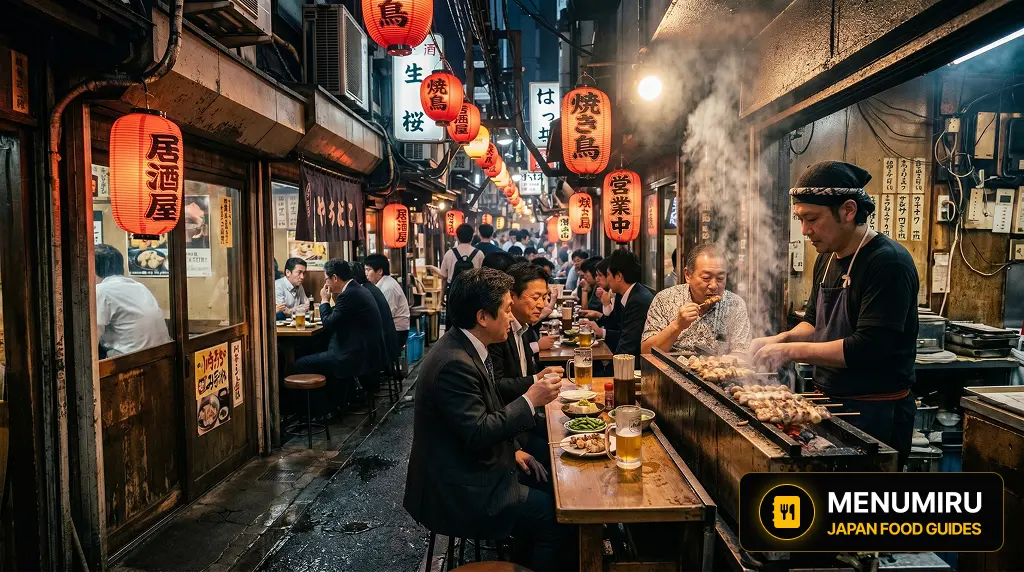
If you want to settle in rather than just fill up, the izakaya (Japanese pub) stays open late almost everywhere, and chain izakaya keep predictable prices and hours. It's the "lots of small dishes + drinks" format, ideal for a group.
Torikizoku (鳥貴族) is a famous yakitori chain with nearly 700 locations nationwide and a single-price gimmick: almost the entire menu (both food and drinks) costs the same — around 360 yen per item. 100% Japanese chicken, grilled over real charcoal to order. Open until deep into the night. The ideal choice when you want yakitori with no surprises on the bill.
Watami (和民) is one of the best-known izakaya chains, founded in 1984 — a more polished format with private booths, a broad menu, and its own farms.
Where to Eat
Omoide Yokocho (思い出横丁) — Shinjuku, "Memory Lane" since 1946. A labyrinth of tiny eateries by Shinjuku's west exit, grown out of the postwar black market of 1946. Smoke from the grills, paper lanterns, counters where you sit shoulder to shoulder with strangers — the most atmospheric late-night izakaya street in Tokyo. The specialties here are yakitori and motsuyaki (grilled offal). Many shops run until late at night.
Andy's Shin Hinomoto (新日の基) — Yurakucho, an izakaya under the tracks run by a Brit. A legendary seafood izakaya right under the railway tracks by Yurakucho Station — trains rumble overhead, adding to the color. It's been running for more than 70 years, managed by Englishman Andy Lunt, who married into the family of the former owners: a rare case of a foreigner running a traditional izakaya. Fresh fish from the market, loud and warm-hearted. Open until midnight (last order 23:10), closed Sundays.
Ebisu Yokocho (恵比寿横丁) — Ebisu, a retro izakaya alley. A covered Showa-style alley with neon and red lanterns: a dozen tiny izakaya under one roof, each with its own specialty — from seafood to the grill. Loud, cramped, fun — perfect for moving from counter to counter all evening. Open until late at night.
Torikizoku Ichigaya (鳥貴族 市ヶ谷店) — the honest chain option. When you want yakitori with no surprises on the bill — the famous single-price chain: almost the whole menu (food and drinks) at ~360 yen, 100% Japanese chicken, grilled over charcoal to order. Open late, predictable, and cheap.
Yatai in Fukuoka (屋台) — the open-air izakaya. The most authentic late-night izakaya is at the counter of a mobile stall on the streets of Fukuoka: oden, yakitori, mentaiko, and ramen straight off the counter, under a lantern, next to the locals. They run from evening until 2 a.m. More in Section 5. Reference point: Nakasu, Hakata-ku, Fukuoka.
4. 🍝 Family Restaurants and Fast Food: A Warm Room Around the Clock
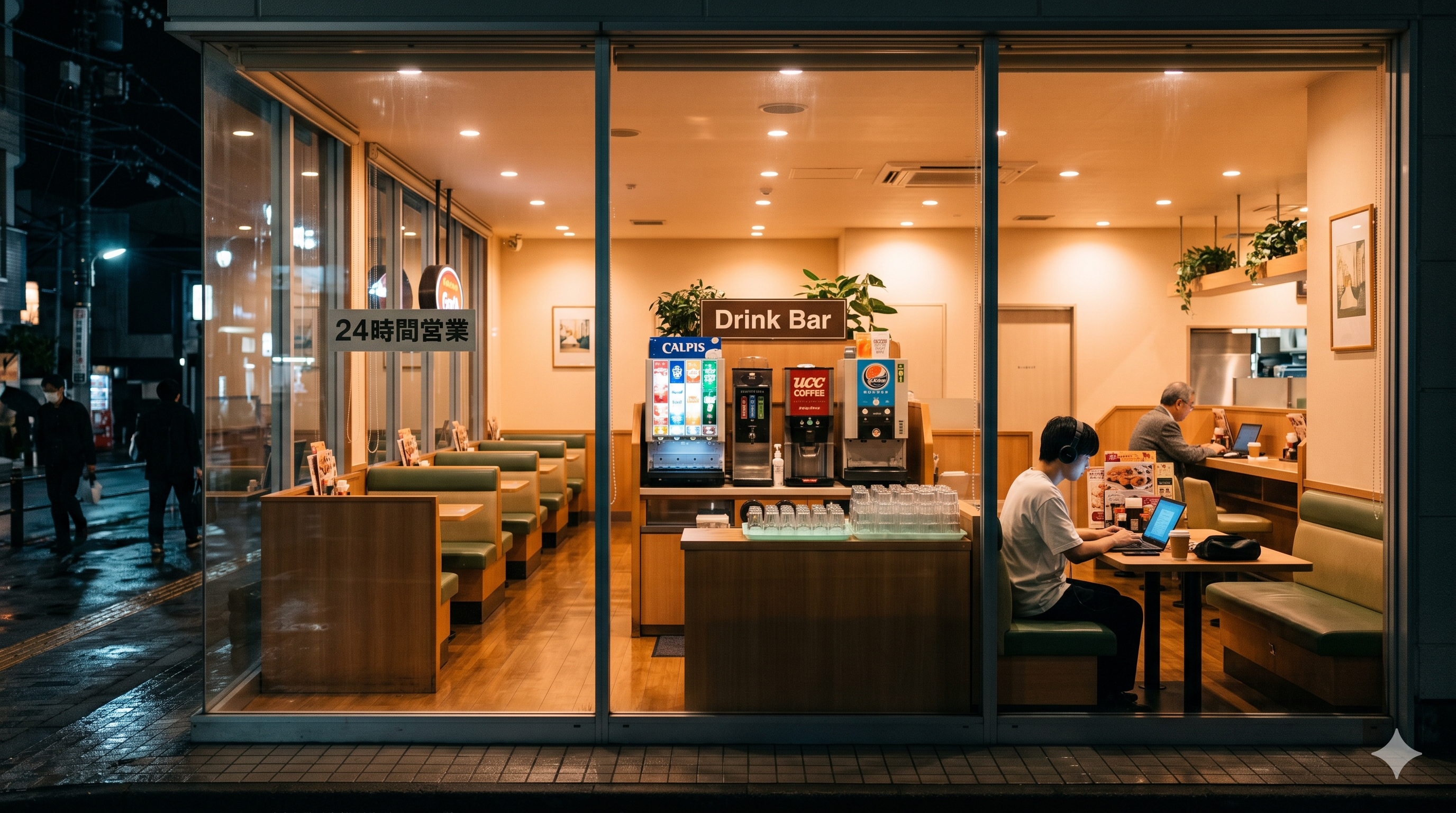
When you just need to sit down somewhere warm, eat, and maybe work on your laptop — famiresu (family restaurants) come to the rescue: chain family cafés with huge menus and low prices. Many are open 24 hours.
Saizeriya (サイゼリヤ) is an Italian family restaurant with legendarily low prices (pasta, pizza, salads for literally a few hundred yen each). About 1,040 locations across Japan (and over 1,600 worldwide). Many outlets are open late.
Gusto (ガスト) is Japan's most recognizable family restaurant, with more than 1,340 locations nationwide. A huge menu, a drink bar with unlimited beverages, and some outlets open around the clock.
McDonald's — in Japan, most "Macs" are open 24 hours.
Where to Eat
Royal Host (ロイヤルホスト) — the "premium" family restaurant, around since 1971. If you want not just cheap but genuinely good, Royal Host is considered the highest-quality of the family restaurants. One of the oldest in the country (since 1971), it's known for its signature beef curry, simmered to a recipe perfected over decades, and for real steaks. Not the cheapest, but noticeably a level above — and many outlets stay open late. Look for the nearest branch in Tokyo's major districts.
Denny's (デニーズ) — the round-the-clock "American" done Japanese-style. Japan's Denny's has long lived a life of its own, unlike the American version: burgers sit alongside Japanese sets, omurice, and seasonal desserts. Many outlets are open 24 hours and save the day when you need to "wait it out" until the first train, with a free coffee refill. Look for a round-the-clock outlet near major stations — for example, in the Akihabara area.
Gusto Shinjuku Yasukunidori (ガスト 新宿靖国通店) — 24 hours in Kabukicho. A 24-hour family restaurant at the epicenter of nighttime Shinjuku. A huge menu, an unlimited drink bar, and power outlets — the classic place to wait out the night until the first train.
Saizeriya Korakuen (サイゼリヤ) — the budget benchmark. An Italian family restaurant with almost indecently low prices: pasta, pizza, and salads for a couple hundred yen, a glass of wine cheaper than a cola. Perfect when you need a lot for not much. The outlet is on the 3rd floor of Don Quijote in Korakuen.
McDonald's Shibuya Center-gai (マクドナルド 渋谷センター街店) — 24 hours. A round-the-clock outlet in the heart of Shibuya, on Center-gai — a lifesaver after a night out.
5. 🏮 Yatai: Street Food Under a Lantern (the Historic Format)
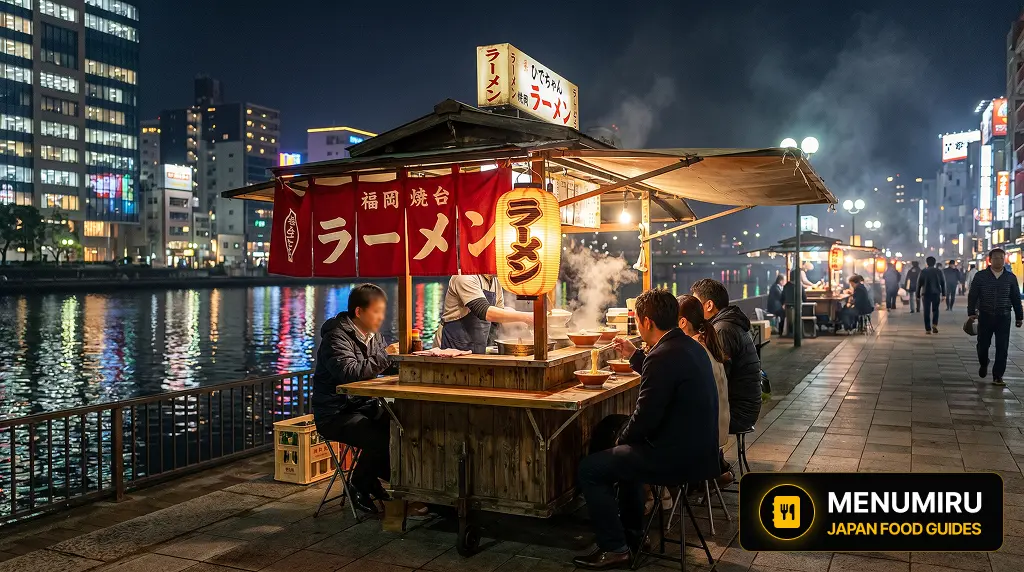
The most atmospheric way to eat at night in Japan is the yatai (屋台) — mobile wooden stalls seating 8–10 under paper lanterns. It's living history: these mobile eateries on wheels appeared back in the Edo period (1603–1868), when soba vendors opened up at night, after the regular shops had closed.
The yatai capital is Fukuoka. Its yatai districts grew up after World War II, when the first stalls fed the impoverished residents of the ruined city. Before the 1964 Olympics, authorities tightened sanitation rules, and the simple carts turned into tidy wooden counters. Today, around 100 yatai operate on Fukuoka's streets in the evenings, usually from 18:00 to 2 a.m., serving ramen, oden, yakitori, okonomiyaki, and mentaiko. Some stalls are surprisingly "old": Yatai Mori in the Nakasu district opened back in 1973.
Where to Eat
The Nakasu Yatai District (中洲屋台街) — Fukuoka The most famous row of yatai — along the bank of the Naka River. Ramen under a lantern, shoulder to shoulder with locals — the postcard nighttime experience of Fukuoka. Reference point: Nakasu, Hakata-ku, Fukuoka (the Naka River bank, near Nakasu-Kawabata Station).
Tenjin Yatai (天神屋台街) — Fukuoka A business district by day, and a scattering of yatai by evening. A bit calmer than touristy Nakasu. Reference point: along Watanabe-dori, Tenjin, Chuo-ku, Fukuoka.
Nagahama Yatai (長浜屋台) — Fukuoka Stalls by the former Nagahama fish market — birthplace of "Nagahama ramen" with its thin noodles. Reference point: Nagahama, Chuo-ku, Fukuoka.
Kita-no-Yatai (北の屋台) — Obihiro, Hokkaido The north's main yatai district: about 20 stalls on a 50-meter lane, 350 m from Obihiro Station — Japanese, Chinese, Asian, and even French cuisine. Open roughly from 17:00 to midnight.
Omoide Yokocho (思い出横丁) — Shinjuku, Tokyo "Memory Lane" by Shinjuku Station — cramped eatery-stalls in the yatai spirit, where yakitori, motsuyaki, and ramen have been served at the counters under red lanterns since the postwar years. Many run until late at night. Reference point: 1-2 Nishishinjuku, Shinjuku-ku, Tokyo.
6. 🏪 Konbini: The 24-Hour Plan "B" (and Often Plan "A")
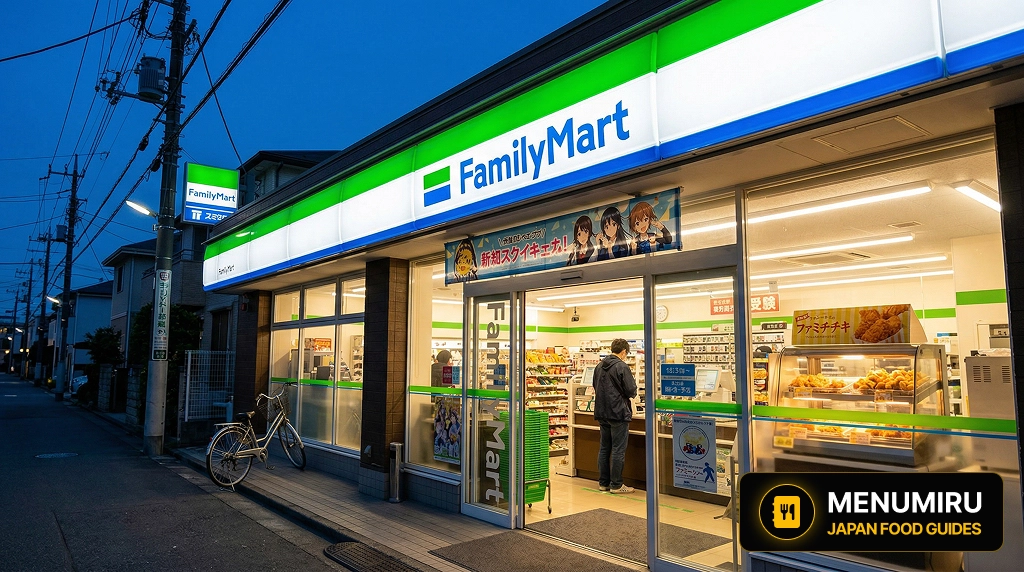
You can't talk about nighttime eating in Japan without mentioning the konbini — the neighborhood convenience stores 7-Eleven, FamilyMart, and Lawson. There are about 57,000 of them in the country, and the overwhelming majority run 24/7. This is no "mere store": hot food (onigiri, niku-man steamed buns, fried chicken, oden from the pot at the register in winter), ready-made bento heated on the spot, noodles, desserts — all fresh and inexpensive.
When everything's closed and you're hungry, the konbini saves you anywhere, from central Tokyo to a village in Hokkaido. Each chain has its own "thing": 7-Eleven has its own high-quality dishes, Lawson its desserts, FamilyMart its signature fried chicken, Famichiki.
💡 We have a separate, detailed guide to konbini — exactly what to grab at 7-Eleven, FamilyMart, and Lawson, how to read the labels, and how not to get lost at the shelves: "Japanese Convenience Store Food Guide: What to Eat at 7-Eleven, FamilyMart & Lawson".
7. ✨ Special Nighttime Spots: History, Views, and Legends
The chains will always feed you, but sometimes you want not just to eat but to be somewhere special. Here are a few nighttime places that are an experience in themselves: centuries of history, a record-breaking tuna, or a view over nighttime Tokyo from on high. Each comes with its own curious fact.
Komakata Dozeu (駒形どぜう) — Asakusa, Tokyo · since 1801. One of Tokyo's oldest restaurants, running since 1801 — a wooden building in the spirit of an Edo-era merchant house, where time seems to have stopped. The signature dish is dojo-nabe, a pot of small river fish (loach) in a sake-and-miso broth, just as it was eaten in old Edo. You sit on tatami at low tables. Open until 22:30 (last order 22:00).
Sushizanmai Tsukiji Honten (すしざんまい 築地本店) — Tsukiji, Tokyo · 24 hours. The first sushi restaurant in Japan to open 24/7 — by the Tsukiji outer market. Fresh fish from the Toyosu market, sushi at three in the morning, accessible prices. The chain's owner, the "tuna king" Kiyoshi Kimura, became famous for buying a giant bluefin tuna at the New Year auction: in January 2026, for a record ¥510 million (about $3.2 million).
Tsurutontan Shinjuku (つるとんたん 新宿店) — udon until 8 a.m. A designer udon brasserie in Kabukicho with giant bowls (you can order the noodles one and a half to two times the normal portion). Open almost around the clock — until 8 a.m. on weekdays — so it saves you after the longest night in Shinjuku.
New York Bar (Park Hyatt Tokyo) — the view from the 52nd floor. The legendary bar on the 52nd floor of the Park Hyatt hotel (the one from Lost in Translation) with a panorama of nighttime Shinjuku, live jazz, and a kitchen running until late at night. Open until midnight (Thu–Sat until 1:00). Not a restaurant chain but an experience — though you can eat here.
The Roof Shibuya Sky — sunset and the night city from 230 m An open-air bar on the roof of the Shibuya Sky observation deck, at a height of 230 m, with a full panorama of Tokyo — Tokyo Tower, Skytree, and on a clear day even Mt. Fuji. Not for a full dinner, but the ideal snack-and-cocktail spot at sunset and in the early night hours (the bar usually runs from 16:00 to 22:00).
How to Plan Nighttime Eating in Japan: In Brief
Check opening hours in advance. Because of reforms (especially at Sukiya) and staff shortages, chains' hours change. A map or app will show the current hours for a specific outlet.
Budget for the night surcharge. A 7–10% charge after 22:00 at the chains is the norm, and it's in the menu. Konbini don't charge it.
The last train is the dividing line. Subways and trains in Japan usually close around midnight — after that it's either a taxi or "waiting it out" in a 24-hour family restaurant or ramen shop until the first train. That, by the way, is a nighttime tradition of its own.
Cash isn't always needed, but sometimes it's mandatory. Some outlets (certain Matsuya, for example) accept only e-money and QR, others only cash. Check at the entrance.
This article is part of MenuMiru's series of guides to Japanese cuisine. MenuMiru helps travelers in Japan read restaurant menus, translate dishes, and find what's right for them.