7 Unique Okinawan Dishes Worth Flying to Japan For
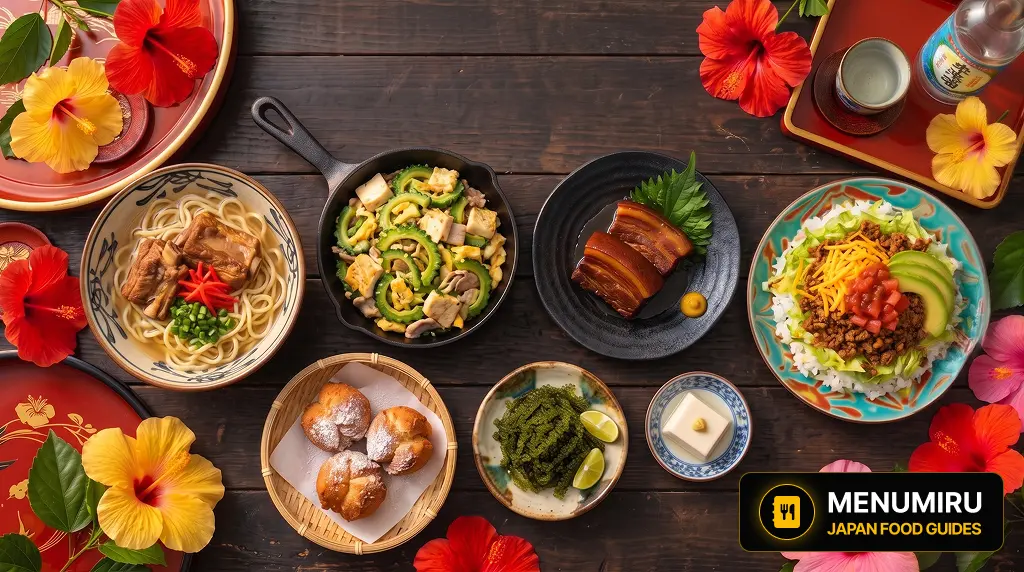
Okinawa is more than just Japan's southernmost prefecture. It is the former Kingdom of Ryukyu, which traded for centuries with China, Southeast Asia, and Korea, and after World War II spent nearly three decades under American administration. All of that history settled onto local plates: people here eat pork like the Chinese, braise dishes like the Japanese, and serve tacos with salsa over rice. If you fly to Okinawa just for the beaches of Onna and the turtles at the Churaumi Aquarium — you'll miss half the experience. Here are seven dishes you'll find almost nowhere else, plus the addresses where locals take their guests.
1. Okinawa Soba (沖縄そば) — The Noodle That Isn't Really Soba
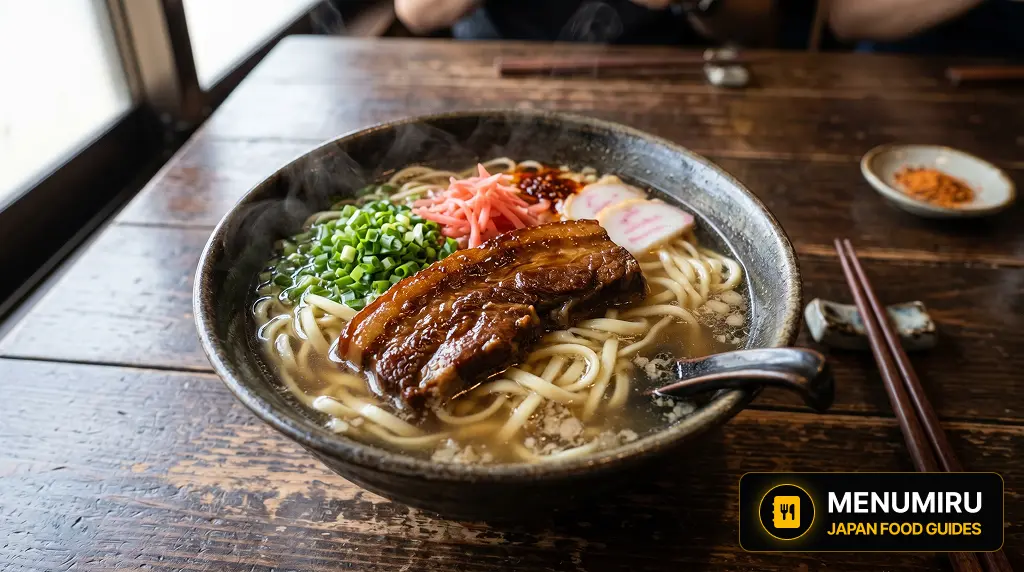
To anyone from mainland Honshu, this isn't soba at all: not a single grain of buckwheat flour, only wheat. Yet in 1978, Okinawa officially won the right to call its dish "soba." The broth is simmered from pork and katsuobushi (bonito flakes), topped with thick flat noodles, pickled red ginger (beni-shoga), and always a piece of meat: either soki ribs or braised san-mai pork belly.
💡 What is soki? Soki (ソーキ) is the Okinawan version of braised pork ribs. The bones with attached meat are simmered for 2–3 hours in a mixture of soy sauce, awamori, sugar, and bonito broth, until the bones can be pulled out with your fingers. Unlike rafute, the meat here is on the bone and the texture is slightly more fibrous. Soki appeared as a soba topping only in the 1960s — and quickly became standard. There are two variations: hon-soki with hard bone, and naki-soki (or soft-soki) — soft cartilage ribs without hard bone, that melt in your mouth.
The dish's history begins in 1902, when a Chinese chef opened a shop selling "Chinese soba" near the Tsuji district in Naha. After the Battle of Okinawa, almost all soba shops were destroyed, and the revival came from internment camps where Americans handed out wheat flour. Machine-cut noodles and the now-standard soki appeared in the 1960s.
Where to eat:
Okinawa Soba EIBUN — the most talked-about soba shop on the island in recent years. A small spot in the pottery district, opened by a young chef who reimagined the classic: triple-aged broth, house-made noodles, and a signature chili oil with island piipatsu pepper. The line forms before opening.
Shuri Horikawa (首里ほりかわ) — a soba shop a few minutes' walk from Shuri Castle, rated 4.4 on Google Maps. They make tofu in-house, the broth has no preservatives or flavor enhancers, and the noodles are rolled out every morning. The flavor is mild, gentle, no aggression — perfect after a long walk through the castle complex. Warm atmosphere, no tourist conveyor belt.
Shinzan Soba (新山そば) — an almost century-old soba shop in the north of the island, using premium local Agu pork. Worth the drive to Nago if you're already heading to the Kojima beaches or Churaumi.
2. Goya Champuru (ゴーヤチャンプルー) — The Bitter Symbol of Longevity
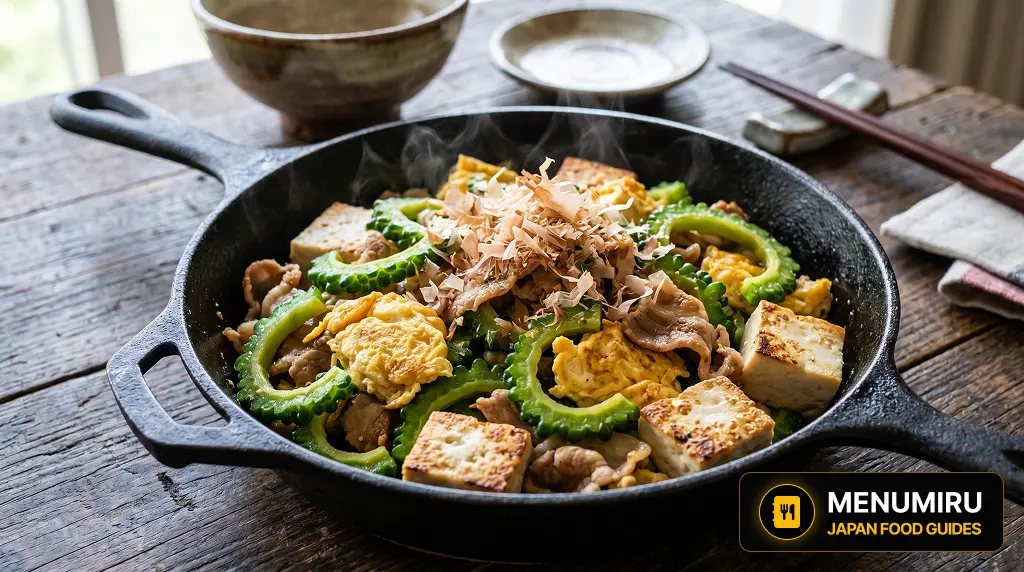
The word "champuru" comes from the Malay campur — "to mix." That tells you everything: for centuries, Okinawans have tossed together whatever was on hand in a single skillet. Goya champuru is the most famous version: bitter melon (momordica), Okinawan island tofu (shima-dofu), egg, and pork or Spam. It sounds wild, but the bitterness of goya is balanced by the rich tofu and slightly sweet egg, and after a few bites you understand why Okinawans live longer than anyone in the world without heart disease.
Where to eat:
Yunangii (ゆうなんぎい) — a family izakaya from 1970, the gold standard of home-style Okinawan cooking. Champuru is cooked with a quick stir-fry over high heat — the goya stays crisp, the tofu gets a golden crust. The atmosphere is village-house cozy, seats are limited, reservations required.
Mikado (みかど) — a 24-hour soul-food spot where taxi drivers, night-shift workers, and students after the bars come to eat. Cheap, loud, authentic. Champuru here is everyday food for locals, not a tourist highlight, and it's all the better for it.
Hanare (沖縄酒場 離〜Hanare〜) — a modern izakaya for those who want champuru in a more stylish setting. The chef adds his own touches to the classic — a drop of truffle oil, crispy chicharrón crumbs on top. A good bridge between tradition and new cuisine.
3. Rafute (ラフテー) — The Pork That Simmers for Half a Day
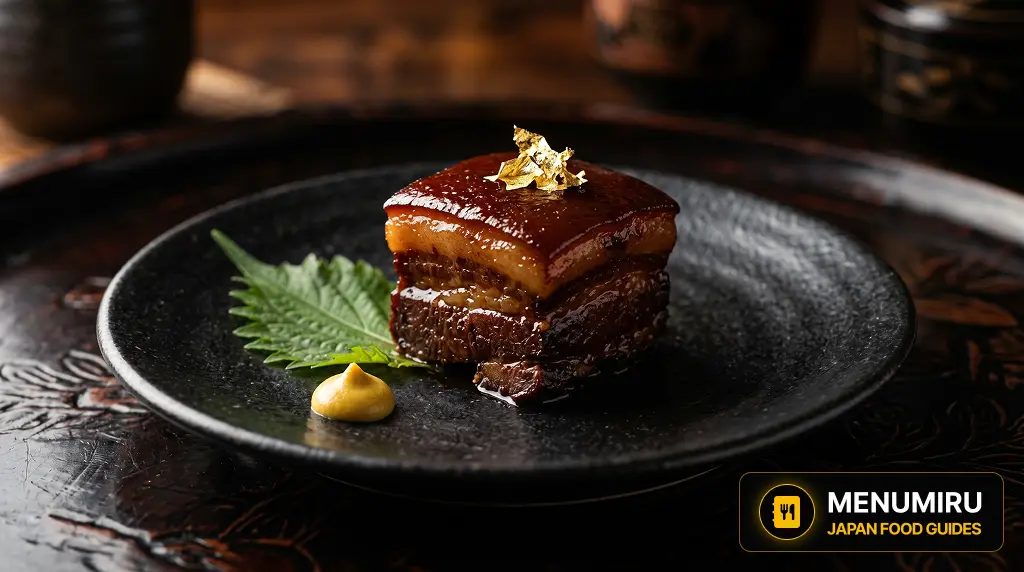
Rafute is a pride of the Ryukyu court. A piece of pork belly is simmered in a mixture of dashi, awamori (the local rice spirit), sugar, and soy sauce until it can be cut with a spoon. The key difference from regular Japanese kakuni is that rafute is always cooked with the skin on, which transforms into a thin gelatinous layer with the flavor of caramelized broth.
In the Kingdom of Ryukyu, this dish was reserved for aristocrats and high officials. Today, everyone eats it, but real rafute takes a chef at least 4–6 hours, so don't order it in cheap places.
Where to eat:
Kuninda (クニンダ) — not just a restaurant but a reconstruction of udun-ryōri, the high cuisine of the Ryukyu royal court. Rafute is served on lacquered trays with edible gold leaf on top, in private rooms styled after the Shō era. Expensive, but it's pure gastronomic theater.
Urizun (うりずん) — the oldest izakaya specializing in traditional Ryukyuan cuisine, opened in 1972. They invented the local dish duru-ten. They brew their own awamori in ceramic jars right in the cellar — there are bottles aged 30+ years. The rafute is tender, grandma-style, no flourishes, and pairs perfectly with a glass of aged awamori.
Tentoten (てんとてん) — a secret soba shop in the Shikina-en area (between Shuri Castle and Shikina Park). Ivy-covered walls, the place looks like a herbalist's hidden refuge. The menu has classics including rafute — but go for the atmosphere and the feeling of having found a place tourists don't know about.
4. Taco Rice (タコライス) — Fast Food That Became a National Dish
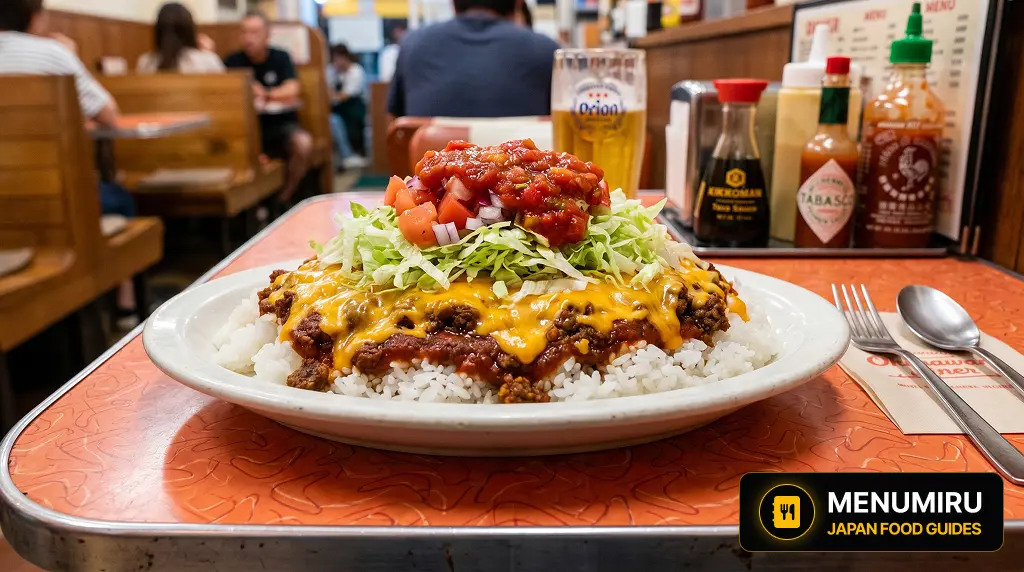
Only Okinawa could have invented this: hot rice topped with Mexican-style ground beef and salsa, shredded cheddar cheese, lettuce, and tomato. Brilliant, cheap, filling. Taco rice was invented in 1984 by Matsuzo Gibo, owner of the small diner Parlor Senri right outside the gates of the American Camp Hansen military base in the city of Kin. Marines came in hungry after their shifts, and Gibo had the idea to swap the fragile tortillas for cheaper, denser rice. He named it for the English-speaking crowd — literally "tacos with rice."
Today, taco rice is in every school cafeteria in Okinawa and even on the menu at the local KFC.
Where to eat:
King Tacos main branch (キングタコス 金武本店) — the place where taco rice began. Direct heir to Parlor Senri (which closed in 2015), now run by the founder's family. Open 10:30 AM to 9 PM, cash only. Portion size is double American — the "regular" here is a "large" anywhere else.
Charlie's Tacos (チャーリー多幸寿) — the first taco shop on the island, founded in 1956. There's no taco rice here as such (it was invented 30 years later), but they serve rare tacos in rice-flour shells — a proprietary technique dating back to the 50s. Stop here if you're interested in the archival side of Okinawan-American history.
Taco Rice Cafe Kijimuna (タコライスカフェ きじむなぁ) — a modern chain where taco rice is served covered with an omelet, like omurice. One-and-a-half-size portions for reasonable money, kid-friendly. A good option if you're heading to the west side of the island and want something quick.
5. Sata Andagi (サーターアンダーギー) — Doughnuts That Crack for Luck
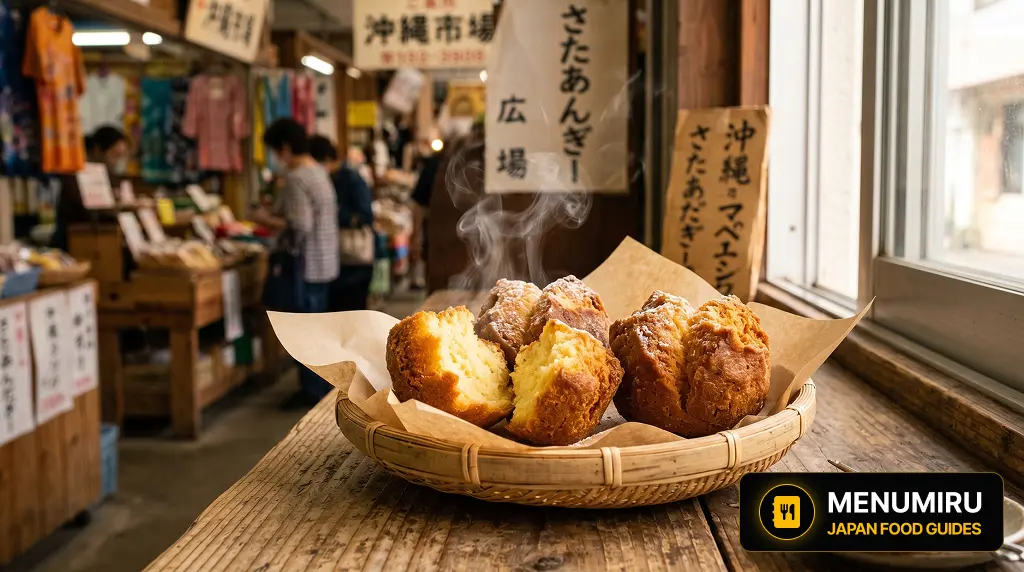
The Okinawan name translates literally as "fried sugar." These are essentially balls of dough made from flour, eggs, and sugar, deep-fried to a dark golden crust. They're crispy on the outside and crumbly on the inside, like a cake. At weddings, they're handed out to guests as a symbol of happiness: the cracked surface looks like a smile.
Where to eat:
Ayumi Sata Andagi (歩サーターアンダーギー) — a viral shop where the first batch each day sells out in 10 minutes. The owner fries small batches constantly, so the balls are always burning hot. Beyond the classic — kokuto (brown sugar), beni-imo (purple sweet potato), coconut. Closed Wednesdays and Sundays.
Matsuhara Confectionery (松原屋製菓) — a traditional confectionery with a 60+ year history. Here, sata andagi isn't a trendy item but part of the everyday neighborhood routine. A large kettle stands right at the entrance where the owner fries balls from early morning. The best "ordinary" classic on the island.
Ryukyu Kashi-Dokoro Ryugu (琉球菓子処 琉宮 平和通り店) — a stand right on the covered Heiwa-dori, a few steps from Makishi Market. Premium presentation and beautiful packaging — perfect souvenir to take home. Exotic flavors: yomogi mugwort, coconut, black sesame. Each ball is slightly smaller than the classic and less sweet.
6. Umibudo (海ぶどう) — Sea Grapes That Pop in Your Mouth
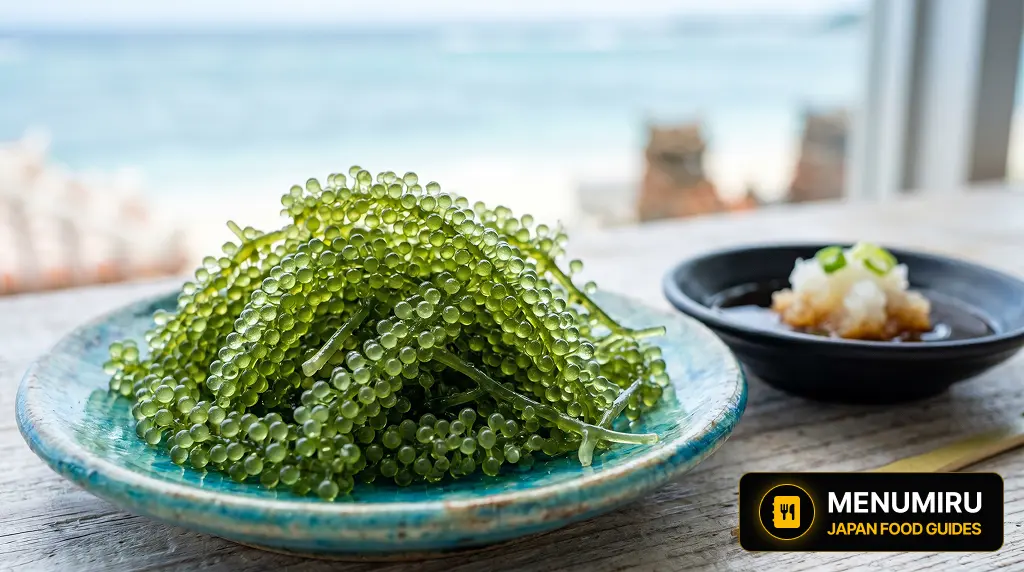
Umibudo isn't really a grape — it's a seaweed (Caulerpa lentillifera) that grows in clusters of tiny green beads. Each bead pops with a slight crunch when bitten and releases a salty sea juice — hence the second name "green caviar." Umibudo is served as an appetizer with rice vinegar, soy sauce, or ponzu wedges. It cannot be stored or refrigerated: the beads will shrivel up immediately. That's why you'll almost never find fresh umibudo outside Okinawa.
The technology for cultivating umibudo in special pools was developed in the 1990s by Munekazu Mekaru of the Onna Village fishing cooperative. Today, Onna is the world capital of sea grapes.
Where to eat:
Hama no Ie (浜の家) — a fishermen's stall-cafe at the seafood market. Opens at 10:00 — and the line forms instantly. Their signature is the umibudo-don, a bowl of hot rice topped with fresh sashimi and a generous cluster of sea grapes (around 750 yen). The catch is brought in from the pier just meters away. The most concentrated "ocean on a plate" you can buy on the island.
Ganso Sea Grapes (元祖海ぶどう 万座毛店) — flagship restaurant called "Original Sea Grapes," founded by a family connected to the umibudo origin story in Onna. They serve full plates of farm-fresh umibudo, umibudo sashimi, and umibudo-don with tuna. Bonus — a built-in shop selling fresh product to take home, and a panoramic view of the turquoise sea from the veranda.
Nagi (沖縄創作料理 ロケーションダイニング凪) — creative Okinawan cuisine 15 minutes from the Ishikawa interchange. They serve umibudo and mozuku with sanbaizu vinegar as a standalone dish to pair with sake, not as an appetizer. Stylish interior, perfect for a romantic dinner after diving the Blue Cave.
7. Jimami Tofu (ジーマミー豆腐) — The Tofu That Has No Soy
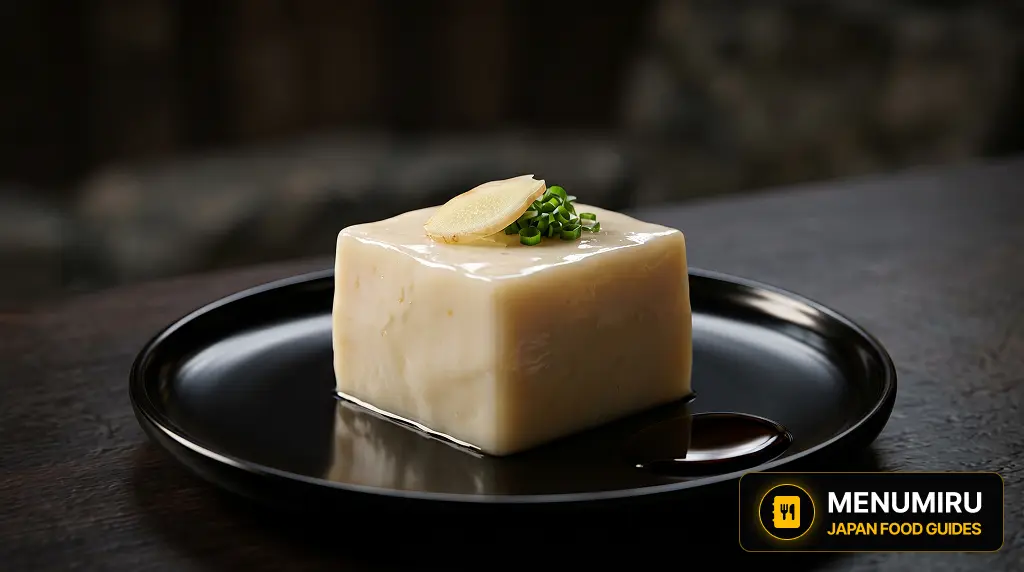
"Jimami" in the Okinawan dialect means "peanut." This tofu is made not from soybeans but from peanut milk, thickened with sweet potato starch. The result is a dense, springy, almost jelly-like mass with a faintly sweet, nutty aroma. In the Kingdom of Ryukyu, jimami tofu was served only at celebrations — peanuts were expensive and considered a luxury.
Today, it's eaten both as an appetizer — with fresh ginger and soy sauce — and as a dessert — with kokuto (brown sugar) syrup and shiso leaves.
Where to eat:
Ryukyuan Cuisine Nuchigafu (ぬちがふぅ) — a restaurant in a hundred-year-old house that survived the Battle of Okinawa. The chef makes jimami tofu from his grandmother's recipe and serves it in a tiny black cup with a single drop of golden miso. Set menu only, reservations required — but this is the most authentic Ryukyu cuisine experience in Naha.
Ma-chinu Ya (まーちぬ家) — a cozy izakaya in an old house, where jimami tofu is served paired with avocado and grated bonito. The menu also includes fresh sashimi, umibudo, and Agu pork steak. A good choice if you want to try several dishes from this article in one place.
Hanasho (花笑) — a tiny "window shop" where jimami tofu is made from scratch every morning (most restaurants buy a ready-made product). You take a portion to go and eat right on the street. Their version is slightly sweeter than usual — the owner adds a bit of kokuto to the peanut milk while cooking.
A 3-Day Food Itinerary
If you want to cover this whole seven without rushing, here's a working plan:
Day 1 (Naha, the classics). Morning — sata andagi at Ayumi at Makishi Market (arrive by 10:00 or you'll miss out). Lunch — soba at Eibun (Tsuboya, ten minutes from the market). Dinner — Urizun in Asato: rafute, 30-year-aged awamori, duru-ten.
Day 2 (central island, drive north). Morning — drive to Kin for taco rice at King Tacos. After lunch — beach and the Manzamo viewpoint in Onna. Lunch-snack with umibudo-don at Hama no Ie at the Onna no Eki market. Dinner at Nagi by Cape Maeda.
Day 3 (Naha, high cuisine). Morning — Shurijō (Shuri Castle) and lunch at Shuri Horikawa just a few minutes' walk from the gates. Evening — set dinner at Nuchigafu, where almost all of Ryukyu royal cuisine is gathered into one menu. A final cocktail at an awamori bar near your hotel.
Okinawan cuisine is about longevity, memory, and the ability to take what's foreign and make it your own. Each of these seven dishes is a small historical document: of war, trade, grandmothers' recipes, and bustling ports. Eat slowly — and don't forget to order a glass of awamori.