How to Read a Japanese Restaurant Menu: The Complete Guide for Tourists (2026)
You found it. Not the tourist trap by the station, but the real deal — the place where locals eat. Small, eight tables, the smell of grilled meat and the sound of sizzling oil. You sit down, someone hands you a warm towel and a menu. You open it — and there's not a single word of English. Just kanji, vertical columns of text, and prices written in... also kanji. The waiter is standing beside you, waiting for your order.
Sound familiar? You're not alone.
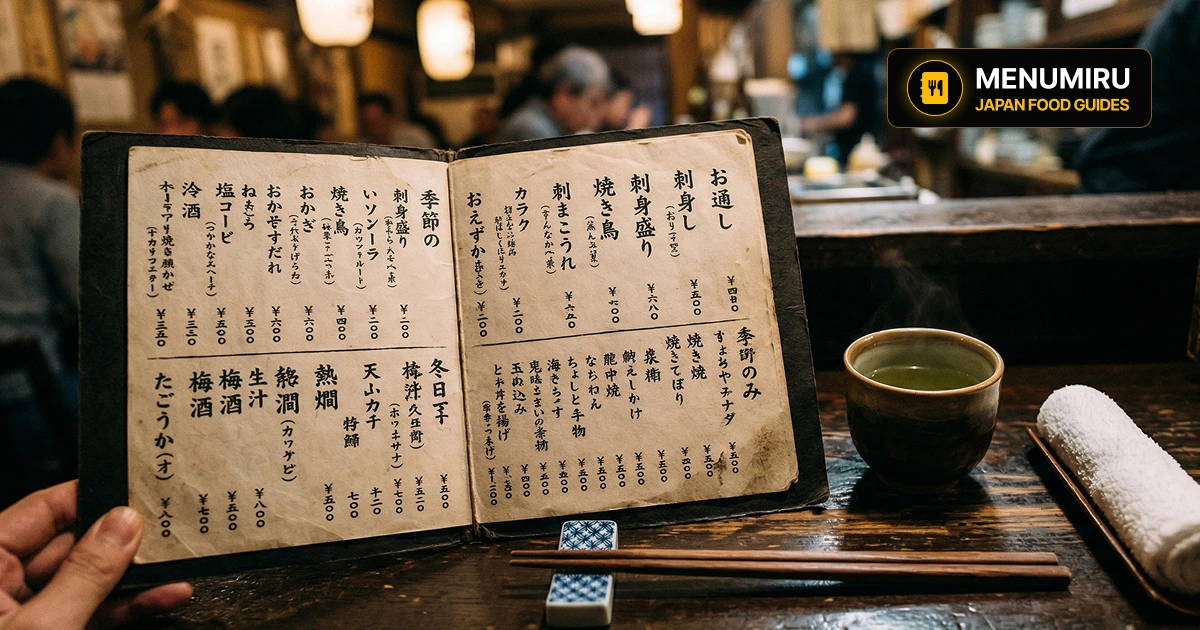
Here's the paradox of dining in Japan: the more authentic the restaurant, the less English you'll find. Chain restaurants in Shibuya or near Tokyo Tower will happily hand you an English menu. But venture away from the center — or step outside Tokyo, Osaka, and Kyoto entirely — and you'll find yourself face to face with a Japanese-only menu. And here's the thing: that's exactly where the best food in the country is hiding.
This guide is your weapon. By the end of it, you'll feel confident walking into any restaurant in Japan, even if you don't speak a word of Japanese.
1. How Japanese Menus Are Structured
A Japanese menu isn't just a list of dishes. It has its own logic and structure that repeats from restaurant to restaurant.
Typical Sections
In most restaurants, you'll encounter roughly the same sequence of sections:
前菜 (ぜんさい, zensai) — appetizers, cold dishes. In izakayas, this section is often the largest.
サラダ (sarada) — salads. Yes, it's just katakana for "salad."
焼き物 (やきもの, yakimono) — grilled dishes.
揚げ物 (あげもの, agemono) — deep-fried items: tempura, karaage, tonkatsu.
煮物 (にもの, nimono) — stewed/simmered dishes.
ご飯もの (ごはんもの, gohan-mono) — rice dishes: donburi, curry, onigiri.
麺類 (めんるい, menrui) — noodles: ramen, udon, soba.
デザート (dezāto) — desserts.
飲み物 (のみもの, nomimono) — drinks.
Different Restaurants, Different Menus
Menu structure varies dramatically depending on the type of establishment. At a ramen shop, instead of an extensive menu, you'll often find a simple list of 5–8 ramen varieties with options for portion size and toppings. At a sushi bar, the menu might be organized by fish type — or there might be no menu at all, with the chef deciding what to serve (this is called おまかせ, omakase). At an izakaya — Japan's answer to the gastropub — the menu will be enormous: dozens of appetizers, mains, rice, noodles, and an extensive drink selection. And at a kaiseki restaurant, instead of a menu, you'll simply receive a course of 7–12 dishes chosen by the chef based on the season.
Reading Direction
Note that some traditional menus read right to left and top to bottom. This isn't a mistake — it's how Japanese has historically been written. In these menus, appetizers will be in the upper right corner, while desserts and drinks are in the lower left.
2. Essential Kanji & Words You'll See Everywhere
You don't need to learn Japanese to navigate a menu. Memorizing 25–30 of the most common words is enough. Here they are:
Core Menu Words
定食 (ていしょく, teishoku) — Set meal — usually a main dish + rice + miso soup + pickle
日替わり (ひがわり, higawari) — Daily special
本日 (ほんじつ, honjitsu) — Today's — often before a special dish
季節 (きせつ, kisetsu) — Seasonal — means it's at peak flavor right now
おすすめ (osusume) — Chef's/house recommendation
人気 (にんき, ninki) — Popular — the most frequently ordered
単品 (たんぴん, tanpin) — Individual dish (not part of a set)
セット (setto) — Set/combo — multiple dishes together
大盛り (おおもり, ōmori) — Large portion
小盛り (こもり, komori) — Small portion
並 (なみ, nami) — Regular size
食べ放題 (たべほうだい, tabehōdai) — All-you-can-eat
飲み放題 (のみほうだい, nomihōdai) — All-you-can-drink
辛い (からい, karai) — Spicy
甘い (あまい, amai) — Sweet
温かい (あたたかい, atatakai) — Hot (temperature)
冷たい (つめたい, tsumetai) — Cold
お持ち帰り (おもちかえり, omochikaeri) — Takeout
限定 (げんてい, gentei) — Limited-time offer
Cooking Methods
焼 (やき, yaki) — Grilled/pan-fried
揚げ (あげ, age) — Deep-fried
煮 (に, ni) — Simmered/stewed
蒸し (むし, mushi) — Steamed
生 (なま, nama) — Raw (as in sushi, sashimi)
刺身 (さしみ, sashimi) — Sliced raw fish
Reading Prices: Japanese Numerals
Here's a trap that few guides warn you about. In authentic izakayas, traditional restaurants, and some ramen shops, prices aren't written in Arabic numerals — they're written in kanji. If you don't know them, you literally cannot tell how much a dish costs.
一 1
二 2
三 3
四 4
五 5
六 6
七 7
八 8
九 9
十 10
百 100 (hyaku)
千 1,000 (sen)
万 10,000 (man)
円 yen (¥)
How it works in practice:
三八〇円 = 380 yen
千二百円 = 1,200 yen
五百八十円 = 580 yen
When you see 三八〇, it's simply digits in a row: 3-8-0. And 千二百 reads as "thousand-two-hundred," i.e. 1,200. It looks intimidating, but after a couple of times it becomes intuitive.
3. Menu Traps Tourists Fall Into
Japanese restaurants aren't trying to deceive you. But there are several things that can catch you off guard if you don't know about them.
お通し (otōshi) — The Mandatory Appetizer
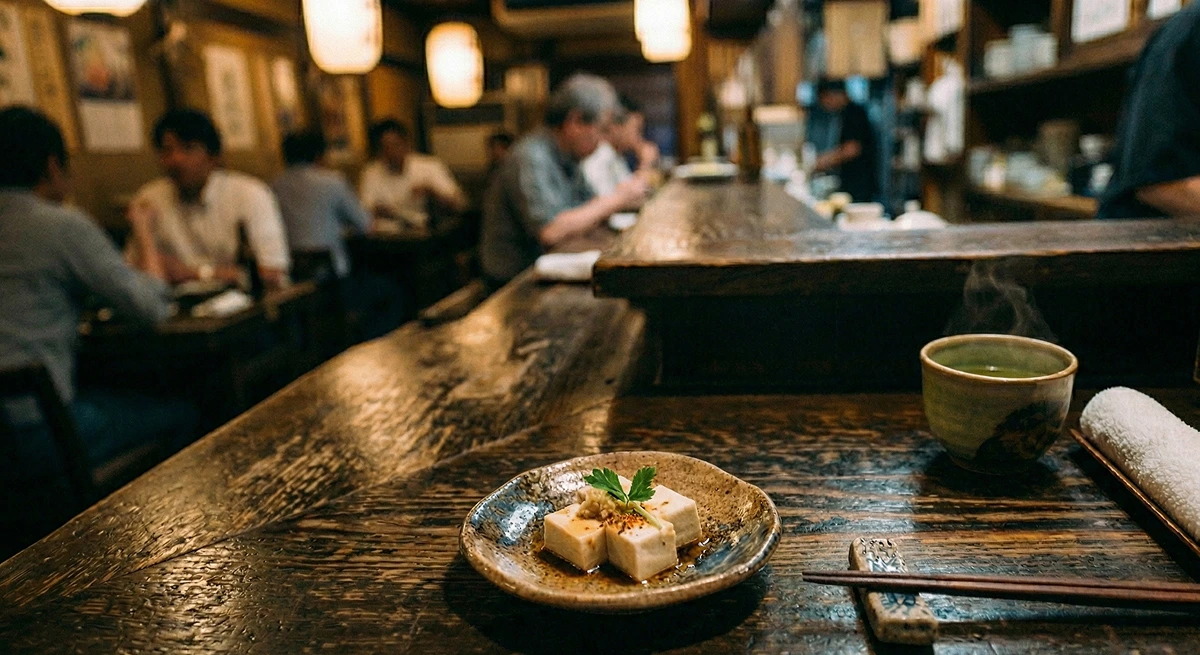
You sit down at an izakaya, haven't ordered anything yet, and a small plate of food appears in front of you. This is お通し — essentially a "cover charge" for the establishment. It's not a gift: you'll be charged 300–500 yen per person. You typically can't refuse it — it's part of izakaya culture. Think of it as a cover charge that comes with a complimentary snack.
時価 (じか, jika) — Market Price
If you see 時価 next to a dish instead of a price, it means "market price" or "price on request." This usually appears next to premium seafood: seasonal fish, crab, uni (sea urchin). It doesn't necessarily mean it'll be expensive, but you should ask. Don't be shy — just point to the word and ask "ikura desu ka?" (いくらですか — "How much is this?").
Prices Without Tax — 税抜 (ぜいぬき, zeinuki) vs 税込 (ぜいこみ, zeikomi)
This is perhaps the most common surprise. You calculated your dinner at 3,000 yen, but at the register they say 3,300. The difference is the consumption tax (消費税, shōhizei), which currently stands at 10%.
Look for the fine print at the bottom of the menu:
税抜 (zeinuki) or (税別, zeibetsu) — price excluding tax. Mentally add 10% to every price.
税込 (zeikomi) — price including tax. You pay exactly what's written.
Prices excluding tax are especially common at izakayas and smaller establishments. Chain restaurants and convenience stores usually show prices with tax included, but it doesn't hurt to double-check. 10% is a noticeable difference, especially on a large order.
サービス料 (sābisu-ryō) — Service Charge
Some restaurants (especially upscale and hotel restaurants) add a service charge to the bill — usually 10%. This is not a tip. Look for the fine print "サービス料 10%" at the bottom of the menu.
Seasonal Dishes With No Description
Sometimes menu items appear handwritten on a piece of paper pinned to the wall. These are seasonal specials. Often they're the best things on the menu. The problem is they're written only in Japanese and frequently without any explanation. If you see one of these — don't ignore it. Point at it and ask.
Portion Sizes
Japanese portions are generally smaller than Western ones. But the difference in sizes within a menu can be unclear:
並 (nami) — standard
大盛り (ōmori) — large portion, usually +100–200 yen
特盛り (tokumori) — extra-large portion (at ramen shops)
At ramen restaurants, noodle quantity is chosen separately: 少なめ (sukuname, less), 普通 (futsū, regular), 大盛り (ōmori, more).
4. Allergens & Dietary Restrictions
Japan is one of the most challenging countries for allergy sufferers and vegetarians. But if you know what to look for, you can keep yourself safe.
Japan's 7 Mandatory Allergens
Japanese law requires labeling of 7 allergen products (特定原材料). They're most often listed at the bottom of the menu or on a separate sheet:
卵 (たまご, tamago) — Egg
s乳 (にゅう, nyū) — Dairy
小麦 (こむぎ, komugi) — Wheat
えび (ebi) — Shrimp
かに (kani) — Crab
そば (soba) — Buckwheat noodles (a serious allergen!)
落花生 (らっかせい, rakkasei) — Peanuts
Beyond these seven, there are 21 additional products recommended for labeling (including tree nuts, sesame, soy, shellfish), but their indication isn't mandatory.
How to Ask About Allergens
The most useful phrase:
「〇〇アレルギーがあります」 ("〇〇 arerugī ga arimasu" — "I have a 〇〇 allergy")
Replace 〇〇 with the relevant food. Even better — prepare a card in Japanese with your allergens beforehand. Most restaurants will be understanding when presented with such a card.
The Vegetarian Trap: Hidden Dashi
If you're vegetarian or vegan, Japan is tricky territory. The main problem: dashi (出汁) — the broth that forms the foundation of nearly all Japanese cuisine. Standard dashi is made from katsuobushi (bonito flake shavings) and kombu (kelp). This means that even "vegetarian" miso soup, tofu, or vegetable tempura may contain fish broth.
What to do:
Look for the word ベジタリアン (bejitarian) or ビーガン (bīgan) — but it's rare.
The phrase 「肉と魚を食べません」 ("niku to sakana o tabemasen" — "I don't eat meat or fish") will be better understood than the word "vegetarian."
Shōjin ryōri (精進料理) — Buddhist temple cuisine — is entirely plant-based. This is the most reliable option for strict vegetarians.
Halal and Kosher Food
The situation is improving, but slowly. In Tokyo and Osaka, there are certified halal restaurants — look for the ハラール (harāru) sign. Outside major cities, they're extremely rare. Kosher restaurants are virtually nonexistent.
5. Types of Restaurants & What to Expect
Each type of Japanese restaurant is its own world with its own rules, prices, and level of accessibility for foreigners.
居酒屋 (Izakaya) — The Japanese Gastropub
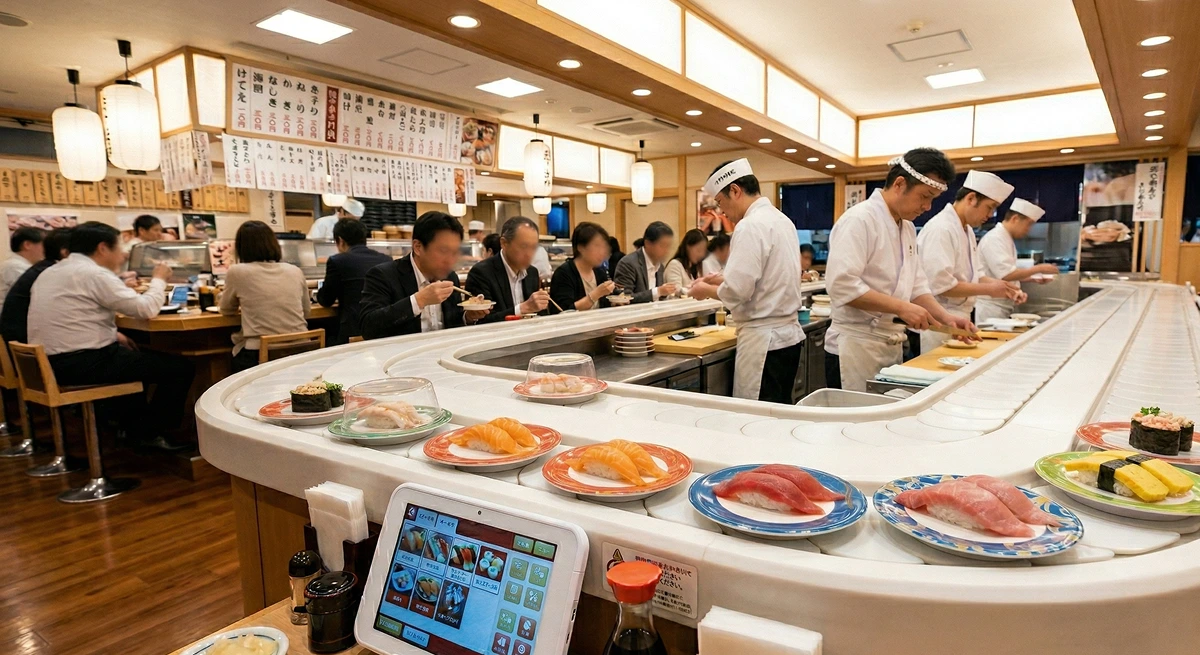
Menu: Huge, 50–100+ items. Appetizers, salads, grilled dishes, rice, noodles, desserts. Often offers nomihōdai (all-you-can-drink for a fixed price, usually 1,500–2,500 yen for 2 hours). Average check: 2,000–4,000 yen per person. English-friendly: In the center of major cities — often yes. In residential neighborhoods and small towns — almost never. Izakayas are where you're most likely to encounter Japanese numerals for prices and handwritten seasonal menus.
ラーメン屋 (Ramen-ya) — Ramen Shop
Menu: Compact. 5–10 ramen varieties, gyoza (dumplings), rice, beer. Average check: 800–1,200 yen. English-friendly: Often has photos of dishes. Ordering via ticket machine — no words needed.
寿司屋 (Sushi-ya) — Sushi Bar
Menu: Depends on the level. Conveyor belt (回転寿司, kaiten-zushi) — tablet with photos, everything is clear. Traditional counter-style — there may be no menu at all. Average check: Conveyor belt — 1,000–2,000 yen. Counter-style — 5,000–15,000+ yen. English-friendly: Conveyor belt — yes, often multilingual. Traditional — depends on the place.
焼肉 (Yakiniku) — Japanese BBQ
Menu: Organized by meat type and cut (カルビ kalbi — short rib, タン tan — tongue, ハラミ harami — skirt steak). Often has a tablet for ordering. Average check: 3,000–6,000 yen. English-friendly: Chains — usually yes. Independent — rarely.
懐石 (Kaiseki) — Traditional Japanese Haute Cuisine
Menu: There may not be one. The chef prepares a course of 7–12 dishes based on seasonal ingredients. Average check: 10,000–30,000+ yen. English-friendly: At high-end establishments, staff often speak English. But this isn't guaranteed.
ファミレス (Family Restaurant)
Menu: Thick, with photos of every dish. Ordering via tablet with language switching. Average check: 800–1,500 yen. English-friendly: Almost always. Chains like Gusto, Saizeriya, and Denny's Japan are your best bet for a guaranteed understanding of the menu.
The Geography Factor
In the tourist zones of Tokyo, Osaka, and Kyoto, English menus are the norm. But move to Sendai, Hiroshima, Kanazawa, or any smaller city, and the level of English drops dramatically. This doesn't mean you shouldn't go there. Quite the opposite — that's where you'll find the most authentic cuisine. Just come prepared.
6. How to Actually Order
So you've figured out the menu. Now — how to actually order your food.
Ticket Machines (食券機, shokkenki)
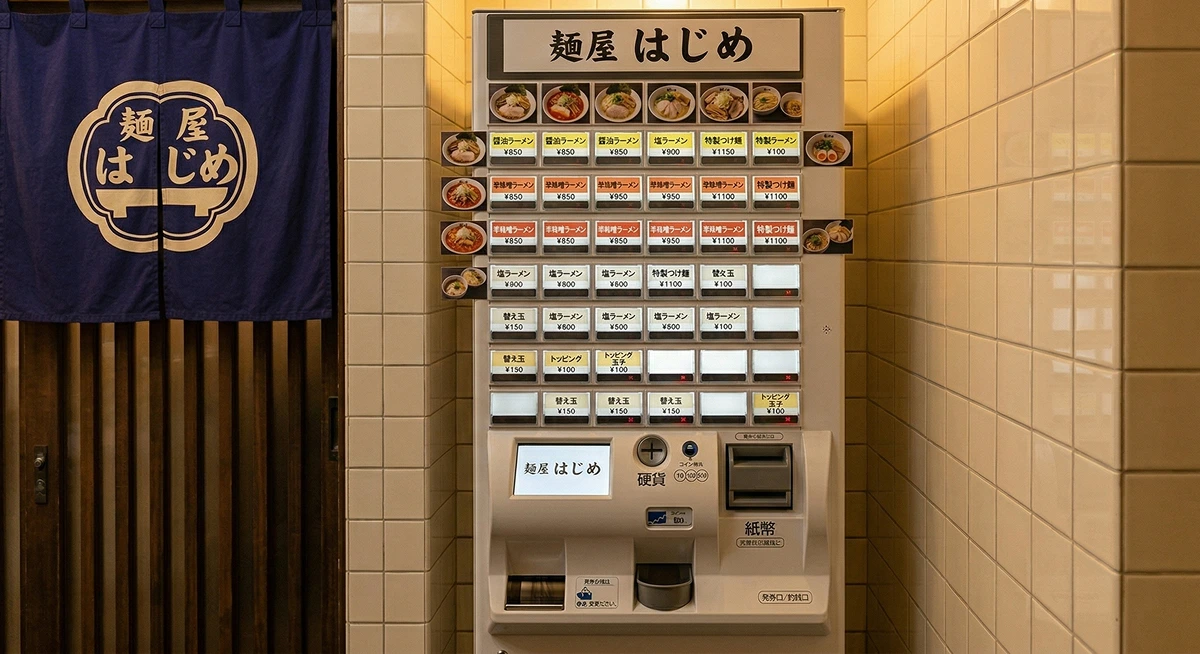
Many ramen shops, gyudon chains (Yoshinoya, Matsuya, Sukiya), and cafeterias use vending machines at the entrance. The process:
Insert money (coins or bills — not all machines accept cards).
Press the button for your desired dish.
Collect your ticket(s) and change.
Hand the ticket to the cook or server.
The problem: buttons are labeled only in Japanese. Pro tip — look for photos of dishes above or beside the machine (they're almost always there).
Tablets and Touch Panels
In chain restaurants, many izakayas, and yakiniku places, each table has a tablet for ordering. Good news: you can often switch the language (look for the 言語 button or a flag icon). Bad news: not every place has an English option, and the translation is sometimes so machine-generated it's more confusing than the Japanese.
The Pointing Method
The simplest and perfectly acceptable approach — point at the menu and say:
「これをお願いします」 ("Kore o onegaishimasu" — "This one, please")
No one will look at you funny. Japanese people are used to foreign tourists and appreciate any attempt at communication. To indicate quantity, hold up fingers.
Calling the Waiter
In Japanese restaurants, the waiter doesn't come to your table to check on you. When you're ready to order, say:
「すみません」 ("Sumimasen" — "Excuse me")
Or press the call button on your table (a small button, often red, labeled 呼出 or チャイム). Most restaurants have one.
Google Translate and the Camera
Many tourists rely on Google Translate's camera feature to read menus. It works... partially. The problems:
Handwritten text — the camera often can't recognize it at all.
Context — "meat on fire" and "pan-fried pork in sauce" are completely different dishes, but the translation might produce the same garbled output.
Culinary terms — many specific Japanese words are translated literally and confusingly. 親子丼 (oyakodon) translates as "parent-child bowl," which doesn't help you understand that it's chicken and egg over rice.
No recommendations — a translation won't tell you what's worth trying or what might not suit your taste.
The camera is better than nothing. But it's a tool with serious limitations.
7. Etiquette, Payment & Tipping
Restaurant etiquette in Japan is a topic in its own right, but here's the most important things to know to avoid any faux pas.
Before the Meal
When your food arrives, say:
「いただきます」 ("Itadakimasu")
This is an expression of gratitude for the meal — roughly equivalent to "bon appétit," but directed at those who prepared the food and the food itself. It's not a religious expression — just part of the culture. You don't have to say it, but it's a nice gesture.
The Wet Towel (おしぼり, oshibori)
You'll receive one as soon as you sit down. Wipe your hands — and only your hands. Not your face, not your neck, not the table. After using it, fold it neatly.
Chopsticks — What NOT to Do
Most chopstick rules are intuitive, but there are two taboos that really matter:
Don't stick chopsticks vertically into rice — this resembles the ritual of offering food to the deceased.
Don't pass food chopstick-to-chopstick — this is associated with the funeral ritual of passing bones.
Everything else is fine. If you can't use chopsticks perfectly — no one will judge you. You can ask for a fork: 「フォークありますか」 ("Fōku arimasu ka?" — "Do you have a fork?").
After the Meal
「ごちそうさまでした」 ("Gochisōsama deshita")
An expression of thanks for a delicious meal. Say this to the cook or server when you leave. It's polite and always brings a smile.
Payment
In Japan, you don't pay at the table. Instead:
Ask for the check: 「お会計お願いします」 ("Okaikei onegaishimasu").
Take the bill and go to the register near the exit.
Pay.
Cash vs cards: Japan is still largely a cash country. Chain restaurants and larger establishments accept cards (look for Visa/Mastercard signs at the entrance). But at small places, ramen shops, and many izakayas — it's cash only. Always carry at least 3,000–5,000 yen in bills and coins.
Electronic payments are also widely used: IC cards (Suica, Pasmo), PayPay, and other QR payments. But for tourists, cash is the most reliable option.
Tipping
There is no tipping in Japan. This isn't a suggestion — it's a rule. Money left on the table will prompt staff to chase after you to return it. If you want to express gratitude, say "gochisōsama deshita" with a smile. That's more than enough.
8. The Easier Way
We wrote this guide so you'd feel confident. But let's be honest: memorizing dozens of kanji, figuring out Japanese numerals, calculating tax, checking allergens — in reality, all of this is harder than it seems when you're reading an article in the comfort of your home.
That's exactly why we built MenuMiru.
The idea is simple: you take a photo of a menu and get an instant translation with an explanation of every dish. Not a machine translation like "parent-child bowl," but a clear description: what the dish is, how it's eaten, what's in it. And if you tell us about your preferences, MenuMiru will suggest what you specifically should try.
We built it because we ran into every single problem in this guide ourselves. And we decided that technology could make this experience better.
FAQ: Common Questions About Dining in Japan
Can I ask for an English menu?
Yes, try saying "English menu, please" or 「英語のメニューはありますか」("Eigo no menyū wa arimasu ka?"). In tourist areas of major cities, they often have one. At smaller establishments and outside Tokyo/Osaka/Kyoto — probably not.
Can I order by just pointing at a dish on the menu?
Absolutely. It's normal and doesn't offend anyone. Point at the dish and say 「これをお願いします」("Kore o onegaishimasu" — "This one, please"). Show quantity with your fingers.
Do I need to leave a tip in Japan?
No. Tipping doesn't exist in Japan. Leaving money on the table may confuse the staff — they'll try to return it to you. The best way to express gratitude is to say 「ごちそうさまでした」("Gochisōsama deshita") when leaving.
What should I do if I have a food allergy?
Prepare a card in Japanese with your allergens ahead of time. The phrase 「〇〇アレルギーがあります」("〇〇 arerugī ga arimasu") means "I have a 〇〇 allergy." The seven mandatory allergens under Japanese law are eggs, dairy, wheat, shrimp, crab, buckwheat noodles (soba), and peanuts.
Do Japanese restaurants accept credit cards?
Chain and larger restaurants — usually yes. Smaller places, ramen shops, and many izakayas — often cash only. Keep at least 3,000–5,000 yen in cash on you. IC cards (Suica, Pasmo) and QR payments (PayPay) are also widely accepted.
What is お通し and why did I get food I didn't order?
お通し (otōshi) is a mandatory appetizer at izakayas — essentially a "cover charge" costing 300–500 yen per person. You usually can't refuse it — it's part of the establishment's culture.
How do I use a ticket machine (食券機)?
Insert money → press the button for your dish → collect your ticket and change → hand the ticket to the staff. If the buttons are only in Japanese, look for photos of dishes above or beside the machine.
Is Japanese food safe for vegetarians?
Be careful: dashi (the fundamental broth of Japanese cuisine) almost always contains bonito flakes (dried tuna). Even "vegetable" dishes, miso soup, and tofu are often prepared with fish broth. The safest option is shōjin ryōri (精進料理), Buddhist temple cuisine, which is entirely plant-based.
How can I tell if the price includes tax or not?
Look at the bottom of the menu: 税込 (zeikomi) = tax included, 税抜 (zeinuki) = tax excluded. If it says 税抜, add 10% to every price. This is especially common at izakayas and smaller restaurants.
What if the prices on the menu are written in Japanese characters?
Key numerals: 一(1), 二(2), 三(3), 四(4), 五(5), 六(6), 七(7), 八(8), 九(9), 百(100), 千(1,000), 円(yen). For example, 三八〇円 = ¥380. You'll most commonly encounter this at izakayas and traditional restaurants.
Bon appétit! Or as they say in Japan — いただきます!